This summer both Wine Junkies swapped the tasting room for a pair of hiking boots and walked the Bernese Oberland. Somewhere between Lake Thun and the Eiger we found something we had not packed for: vines.
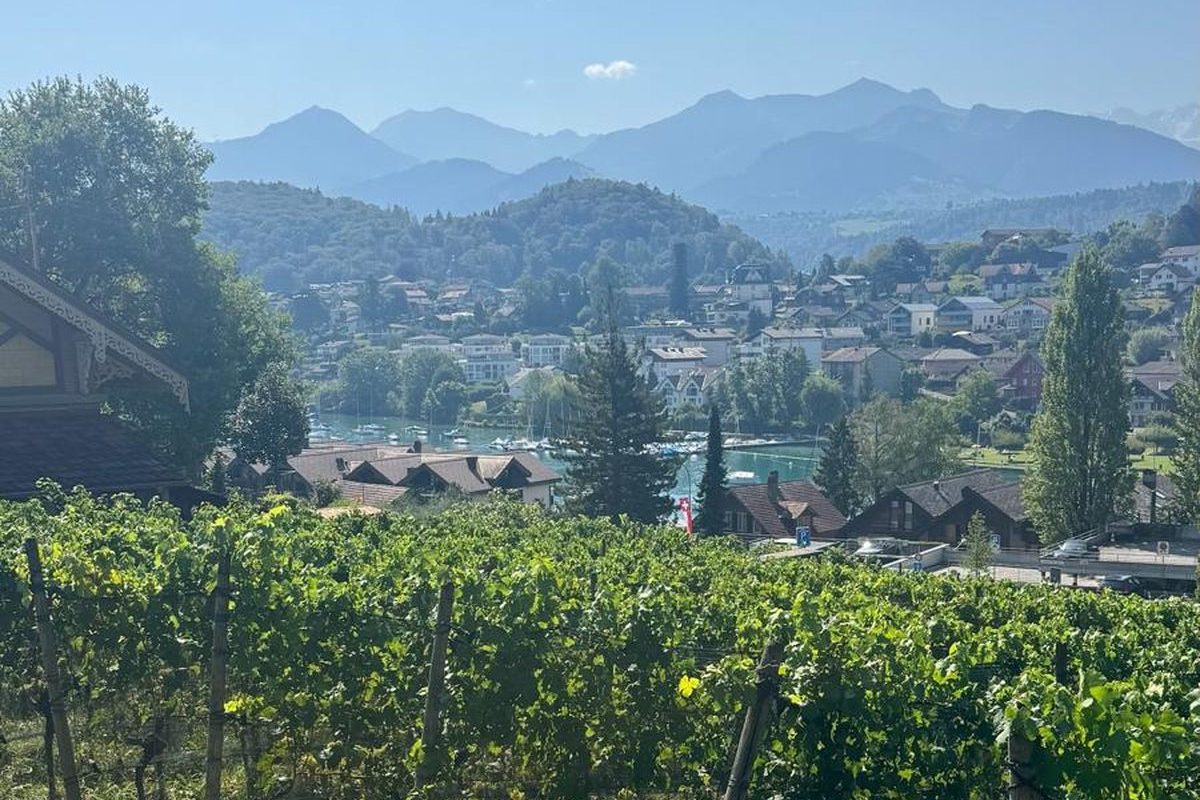
Think of the Jungfrau region and you think of cogwheel trains grinding up to the Eiger, cows with bells the size of buckets, and a fondue you regret at 2,000 metres. Wine is nowhere on that list. We were travelling back to Zurich and decided to make a spontaneous detour, that’s why we spent a morning walking up a very steep hill above Spiez with our backpacks on. It was here that we were told that “there is wine here, but it doesn’t leave the valley.”
They call it Alpenwein: wine grown under genuinely alpine conditions, on slopes that were arguably never meant for a vine. And once you know it is there, you start seeing it everywhere along the southern shore of Lake Thun.
The vineyard file — Spiez, Lake Thun
994 first documented mention · 11.5 hectares under vine today · 600 metres above sea level · around 80,000 bottles a year
994, and then nothing
Wine has been made on this shoulder of rock for more than a thousand years — the first written mention of vines at Lake Thun dates from 994. By the eighteenth century the slopes around Spiez carried something like 45 hectares, which for a village in the Bernese Oberland is a serious amount of wine.
And then it stopped. Mildew, cheap imports arriving by rail, and a climate that punishes anyone who gets greedy with yields. The last vines were pulled out in 1915. For a decade there was no vineyard here at all.
What brought it back was not an investor but a club: a group of local Rebfreunde — vine friends — who started replanting in 1926 and who, in 1942, formed the cooperative that still runs the place. That structure matters. Nobody here is farming a trophy estate. The wine is made in the historic cellars beneath Spiez Castle, the harvest is picked by hand because a machine on these terraces would simply fall off, and the whole operation makes somewhere between 75,000 and 85,000 bottles a year. For comparison, that is roughly what a mid-sized Bordeaux château produces before lunch.
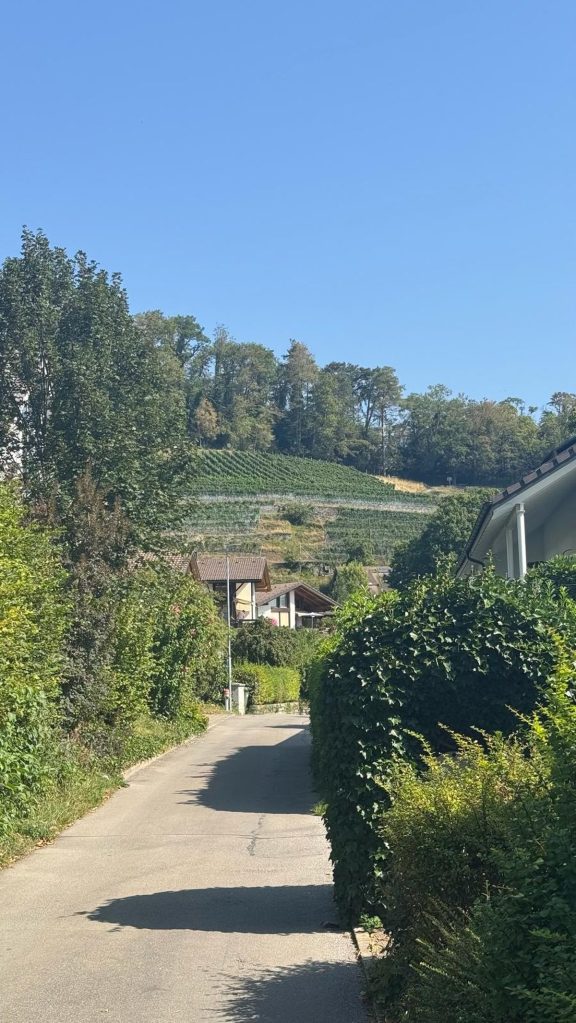
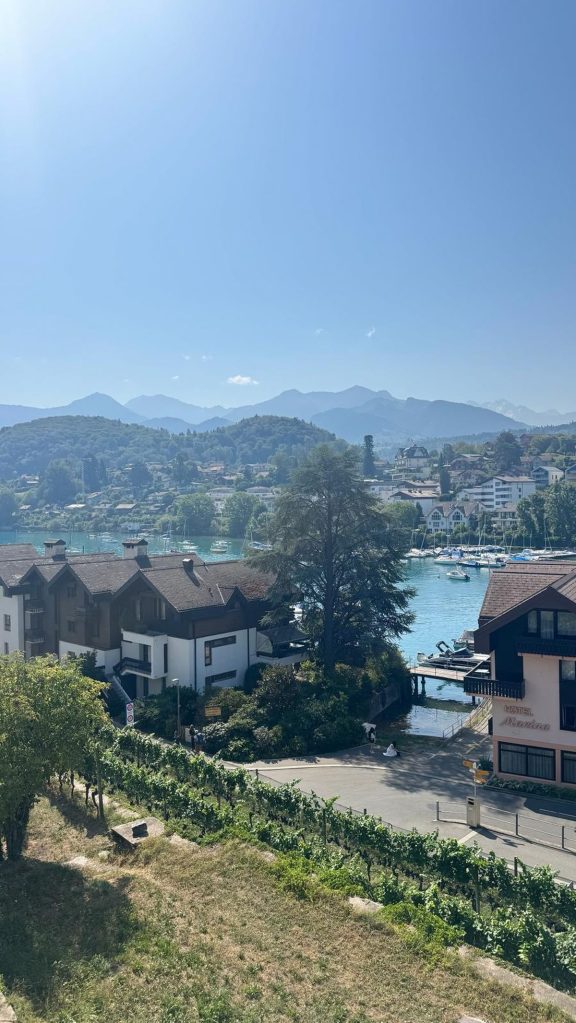
Why anything ripens up here at all
Standing in the rows, the question is not “is this good wine?” but “how is this wine at all?” Three things are doing the work, and you can see all of them from the same spot.
- The slope. These are steep, south-facing terraces. Tilt a hillside towards the sun and you effectively move it a few hundred kilometres south — the same light hits a smaller patch of ground, and the stony soil holds that heat into the night.
- The lake. Lake Thun is an enormous thermal battery. It soaks up warmth through the summer, releases it slowly into autumn, and bounces sunlight back up onto the slope like a reflector. It also takes the edge off spring frost, which at 600 metres is not a small thing.
- The föhn. That warm, dry wind that falls down off the Alps and makes half of Switzerland complain about headaches is a gift to a grape grower. It pushes temperatures up and, more importantly, dries the canopy after rain — which is how you keep rot out of a vineyard in a wet alpine summer.
What altitude adds on top is the swing: hot afternoons, genuinely cold nights. Grapes ripen their sugars in the day and hang on to their acidity overnight, and that gap is the whole alpine signature. These wines are pale, high-toned and taut. They are never plush, and they are not trying to be.
Alpine wine is not warm-climate wine with a nice view. It tastes like the place it comes from: cool, tight, and slightly nervous.
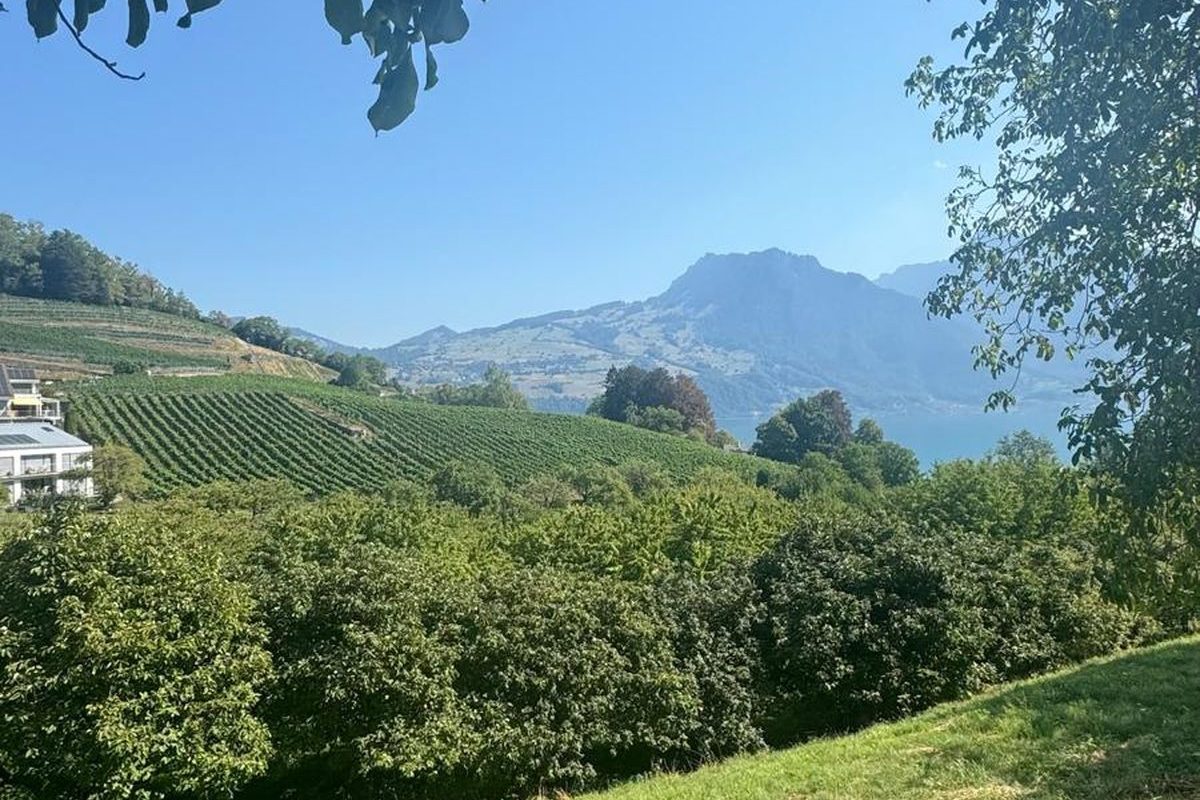
What is actually in the glass
Riesling-Sylvaner is the house white, and it is worth explaining the name. It is the same grape the rest of the world calls Müller-Thurgau — and the Swiss have the better claim to it, since Hermann Müller, who bred it, came from the canton of Thurgau. Grown at altitude and picked properly, it is floral and light on its feet, with white peach, a bit of elderflower and a green, nettly edge that keeps it honest.
Blauburgunder — Pinot Noir, in Swiss German — is the red. Pale, translucent, red-fruited, with barely any tannin to speak of. Serve it at 14°C, not room temperature, and it makes complete sense next to air-dried beef and alpine cheese. There is Pinot Gris and Sauvignon Blanc here too.
And then the interesting ones: Cabernet Jura, Sauvignac and Souvignier Gris. If those names mean nothing to you, that is the point — they are PIWIs.
The PIWI question
Pilzwiderstandsfähige Rebsorten: fungus-resistant grape varieties. They are crossings bred to shrug off downy and powdery mildew, the two diseases that make a wet, cool growing season miserable and that normally get answered with repeated spraying.
On a terrace like this one, that argument wins on practicality alone. Every treatment has to be carried up the slope by a person, and whatever you spray ends up heading downhill towards a lake that the entire village swims in. A vine that needs a fraction of the sprays is not an ideological choice here — it is the only sensible one.
Both Cabernet Jura and Sauvignac come from Valentin Blattner, the Swiss vine breeder working out of the Jura who has quietly become one of the most influential people in European viticulture without ever making a famous wine. Alpine growers adopted these varieties early because their weather forced the issue. The rest of Europe is now catching up in a hurry.
How high is high?
Where the vines sit, metres above sea level: Médoc around 20 m · Alsace hillsides 200–400 m · Spiez around 600 m · Visperterminen 650–1,150 m
Six hundred metres sounds dramatic until you drive an hour south into the Valais. At Visperterminen, vines climb to 1,150 metres — the highest in Europe — planted with Heida, the grape the French know as Savagnin Blanc. What makes Spiez unusual is not raw altitude but latitude: it is one of the highest vineyards north of the Alps, on the wrong side of the mountains for easy ripening.
Switzerland as a whole is a wonderfully strange wine country. Around 250 grape varieties across all 26 cantons, roughly 99 million litres a year, Chasselas alone accounting for a quarter of the vineyard area — and about one per cent of it gets exported. The Swiss drink their own wine, happily, at prices no one else would pay. Longtime readers will recognise the pattern from our trip to Tasmania, where the locals also keep the good stuff for themselves.
Which leads to the only practical advice that matters: you are not going to find this bottle at home. Drink it there.
If you go
- Walk it. The Spiez vineyard trail climbs straight up from the harbour — twenty minutes, properly steep, and the view over the bay does most of the talking. Take water; there is no shade in the rows.
- Buy at the cellar. The cooperative sells from Schlossstrasse in Spiez, mornings on weekdays, year round.
- Taste on the right day. Tastings run Wednesday evenings from May to December, and Saturday mornings in early summer. Book ahead — this is a small operation, not a visitor centre.
- Eat locally. Riesling-Sylvaner with lake fish — perch or féra — is the obvious pairing and it is obvious for a reason. Blauburgunder with Bündnerfleisch and a hard alpine cheese.
We came to the Jungfrau region to hike and left inspired to write another post. The first in years! Alpenwein will never be a category that fills supermarket shelves — the volumes are far too small and the slopes far too steep — but it is one of the most honest expressions of place we have tasted in years. A thousand years of stubbornness, eleven and a half hectares, and a lake doing the heavy lifting.
Have you stumbled across wine somewhere it had no business being? Tell us in the comments — we are collecting them.
Santé!
Albert & Willem

