The last thing we published before this blog went quiet for six years was a question: is non-alcoholic wine something to consider? We ended it with a prediction. It is time to find out whether we were right — and which bottle is actually worth opening.
In August 2020 we wrote a short piece on alcohol-free wine. Beer had already cracked the category. Wine had not. We explained how the alcohol gets taken out, named four producers worth a look, and closed on a fairly bold line: it was only a matter of time before alcohol-free wine got good enough to replace the real thing.
Then we stopped writing for six years. The category did not stop.
The file — six years of alcohol-free wine
Aug 2020 last post · +9% global no-alcohol volume in 2025 · 208 medals at Mundus Vini Non-Alcoholic 2026 ·
What we got right
The prediction about quality, mostly. In 2020 alcohol-free wine was a supermarket curiosity and a favour to the designated driver. By 2025 it was a line item in the strategy decks of the biggest wine houses on earth.
The clearest signal came in October 2024, when Moët Hennessy — the LVMH division behind Dom Pérignon, Krug and Veuve Clicquot — bought a minority stake in French Bloom, an alcohol-free sparkling brand made from organic Chardonnay and Pinot Noir. It was the group’s first investment in the category. French Bloom made around 500,000 bottles in 2024 and has since built its own estate in Limoux. When the people who sell the most expensive fizz in the world buy into the version without alcohol, the question “is this a real category?” has been answered.
The numbers say the same thing. IWSR, which tracks drinks volumes across the big markets, reckons global no-alcohol volume (beer, wine, spirits and RTDs together) grew about 9% in 2025 and will grow by more than a third between 2024 and 2029. For wine specifically, no-alcohol volumes rose in every one of the eight big markets it tracks between 2019 and 2024 — slowly in the old wine countries (France around 4% a year, Spain 6%, Germany 9%), fast almost everywhere else (the UK 15%, Australia 18%, the US 23%, Japan 26%, Canada 27%). The newest wine-drinking cultures are the ones embracing it fastest.
What we got wrong
The word replacement. Nobody we know has swapped wine for alcohol-free wine, and the data says hardly anyone has. IWSR counted 61 million new no-alcohol drinkers across its top ten markets between 2022 and 2024, and its own framing has shifted from abstinence to moderation: most of these people still drink. They just drink less, or not on a Tuesday, or not on the night they are driving home. Younger drinkers lead the way, and they tend to moderate in seasons — a dry January here, a sober October there — rather than for good.
That changes what an alcohol-free wine is for. It is not a substitute for a Barolo. It is a substitute for the fourth glass, the business lunch, the Dry January, the pregnancy, the training block. Judged as a replacement, most of it still disappoints. Judged as a companion, a surprising amount of it now works.
The bottles we named in 2020
Three of the four producers we mentioned are still in the game, and all three went further than we expected.
Leitz, Rheingau. Johannes Leitz’s Eins-Zwei-Zero was the name everyone quoted in 2020, when it meant a still and a sparkling Riesling. It is now a family: a sparkling rosé from Pinot Noir, a sparkling Blanc de Blancs, a Chardonnay, even a Sauvignon Blanc under a separate Zero Point Five label. The Riesling has become one of the reference points for the whole category.
Thomson & Scott, Noughty. Back then it was one organic sparkling Chardonnay making big claims. It is still organic, still vegan, now halal-certified and a B Corp, and the range has grown into still red, white and rosé. The base wine comes from southern Spain and loses its alcohol by vacuum distillation, with the aromas captured and returned — exactly the process we described six years ago.
Familia Torres, Natureo. Torres was the veteran even then: research started in 2004, the first Natureo (a Muscat of Alexandria) launched in 2008, and the range went fully alcohol-free in 2016. What we did not see coming was the scale of the bet. Torres is spending around €6 million between 2024 and 2026 on a winery in Penedès that makes nothing but alcohol-free wine, and it keeps collecting medals for it (more on that below).
The law caught up
For most of the last six years, the label on an alcohol-free wine was a legal mess — different rules in different countries, and clumsy terms like “dealcoholised” and “partially dealcoholised” that no one says out loud.
In Europe, that ended on 18 March 2026, when the EU’s new wine regulation (2026/471) came into force. Since Germany, Spain and France dominate the category’s medal tables, these are the words you will see on a lot of bottles wherever you live:
- “Alcohol-free” — no more than 0.5% alcohol.
- “Alcohol-free 0.0%” — no more than 0.05%.
- “Reduced-alcohol” — above 0.5%, and at least 30% below the normal strength for that type of wine.
The bigger change got fewer headlines. Wines with a protected name — a PDO or PGI — can now be dealcoholised and keep that name. Until this spring an alcohol-free wine could not legally carry the name of the appellation its grapes came from. Don’t expect a 0.0% Grand Cru on the shelf next month, but the legal door is open, and some very old regions will be watching the French Bloom sales figures closely. You will still see the old wording on shelves for a while: producers have until September 2027 to switch, and existing stock can sell through.
The problem nobody solved
In 2020 we wrote that alcohol carries a wine’s aroma out of the glass and up to your nose, so take the alcohol away and you take the delivery system with it. Six years of engineering later, that is still the core problem. The three methods are the same three — vacuum distillation, spinning cone, reverse osmosis — refined, gentler, better at catching aromas and putting them back. But alcohol also gives wine its weight: the glycerol-like roundness that fills your mouth. Remove it and a wine goes thin.
Producers have one reliable fix for thin, and it is sugar. A Brut Champagne is allowed up to 12 grams per litre. Noughty’s sparkling Chardonnay lists 29. Retailers put the Leitz sparkling Riesling at around 45. Nobody is hiding this — it is on the label — but it explains most of what you taste.
It also explains why the category’s winners are almost all sparkling. Bubbles and acidity do much of the lifting alcohol used to do, and the sugar reads as balance rather than sweetness. Aromatic whites come next: Riesling, Muscat and Sauvignon Blanc bring enough perfume of their own to survive the process. Still reds remain the hardest trick in the book, because a red without alcohol loses its structure precisely where tannin needs support.
Alcohol-free wine is at its best when it stops pretending to be wine and starts behaving like a good sparkling drink with a vineyard behind it.
So which one is the best?
It depends who you ask — and, more and more, the answer is not a dealcoholised wine at all.
Ask the judges. Mundus Vini Non-Alcoholic, the German competition that has become the category’s main benchmark, handed out 208 medals this year and exactly one Grand Gold: Breakaway, a dealcoholised Pinot Blanc from the German estate Bergdolt-Reif & Nett. Best producers of the year were Les Grands Chais de France, Familia Torres and Carl Jung, and Torres’s Natureo Rosé took gold and best of show for Spanish rosé. The medal table reads like a map of where the know-how is: Germany first by a distance, then Spain, then France.
Ask the critics. In January, Wine Spectator blind-tasted 50 dealcoholised wines from 26 producers and recommended 12. There was no single winner. Sparkling did best, aromatic whites next, and the reds mostly came across as awkward — too much sugar, acidity out of balance. The bottle that tasted most like its place was Ernst Loosen’s Dr. Lo Riesling from the Mosel; Kim Crawford’s Illuminate Sauvignon Blanc from New Zealand was close behind, and a South African Cabernet–Merlot from Misty Cliffs was the only red with real grip. The magazine’s conclusion was blunt: as currently made, these wines “cannot convincingly stand in for the real thing.”
Ask the sommeliers. This is where it gets interesting. Look at the non-alcoholic pairings at Michelin-starred restaurants and you find teas, kombucha, amazake and house-made ferments — and only occasionally a dealcoholised wine, usually a German Riesling. Alongside them sits a new shelf of “wine alternatives” that do not start from wine at all, built instead to do wine’s job at the table: acidity, tannin, a little bitterness, length.
- Muri (Copenhagen) — fermented drinks from a team of chefs and drinks makers, with flavours like sour cherry and beetroot, or koji rice and smoked lavender.
- Non (Australia) — built on verjus, the juice of unripe grapes, with enough tannin to stand up to food.
- Baek — founded by a former sommelier of Oslo’s three-star Maaemo, blending fruit, grapes and spice.
- Copenhagen Sparkling Tea — organic teas made to fizz and pour like Champagne.
Our answer. If you want something that tastes like wine, buy a sparkling or an aromatic white, and let Germany lead: the Leitz or the Dr. Lo Riesling, or the Breakaway if you can find it. If you want something that does what wine does over dinner, try one of the new alternatives. After six years of waiting, the best alcohol-free wine might not be wine.
On the list
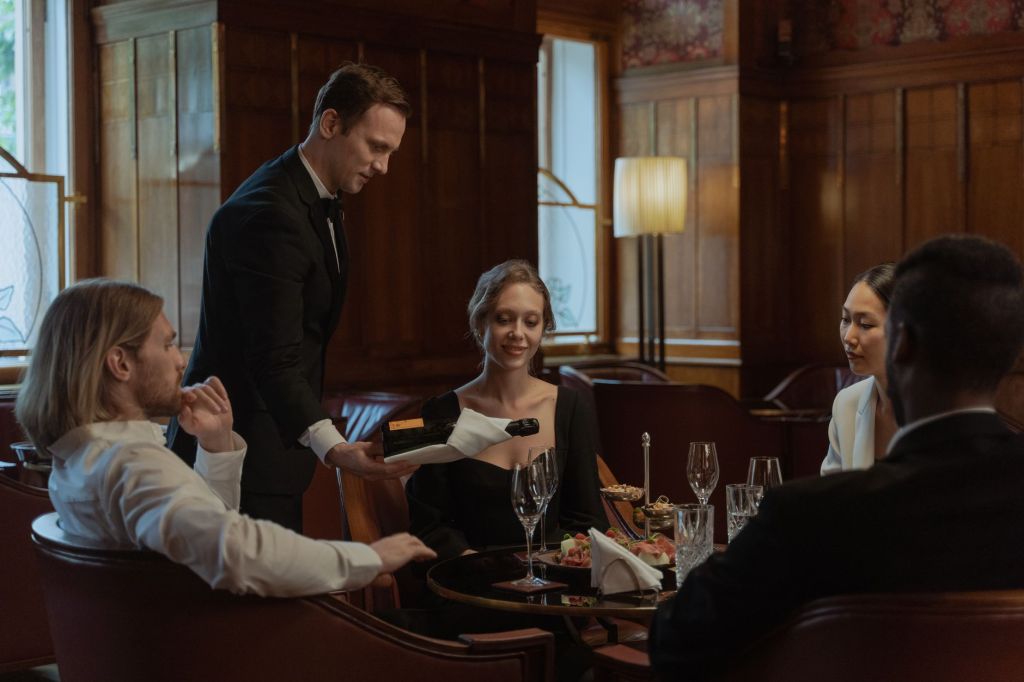
Anyone who has built a wine list knows the alcohol-free line used to be an afterthought: one sparkling, bought because someone asked once, poured flat because the bottle had been open since Tuesday. That is no longer good enough. A guest who is not drinking still wants a proper glass, a proper pour and a reason to toast, and they will pay for it. The better lists now treat alcohol-free drinks the way they treat everything else by the glass: a small number of bottles, chosen deliberately, served cold and fresh — and the most ambitious ones build a full pairing, course by course.
What is in our glasses
If you want to try it
- Start with bubbles. Sparkling is where the category is genuinely good. Still reds last.
- Read the sugar. Anything much above 30 g/L is going to taste sweet with food. In the EU the energy value is now on the label and full nutrition sits behind a QR code.
- Drink it young. There is no cellaring potential here. Alcohol is a preservative; without it, freshness fades fast. Check the date, buy what you will drink this season.
- Serve it colder than you think. A couple of degrees below the real thing tightens the sweetness and hides the thinness.
- Don’t save it. An open alcohol-free bottle loses its lift faster than wine. Half bottles, if you can find them.
- Look beyond wine. For dinner, a good wine alternative or a sparkling tea often pairs better than a dealcoholised red.
- Judge it as itself. Put it next to a Champagne and it loses. Put it next to a soda water on a Friday night and it wins every time.
So: was non-alcoholic wine something to consider? Six years on, yes — just not in the way we thought. It did not replace wine. It made room next to it. And if the biggest names in Champagne and the lawmakers in Brussels have both caught up, it is probably time the two of us did too.
Have you found an alcohol-free wine that actually made you forget what was missing? Tell us in the comments — especially if it is a red. We have been looking for six years.
Santé!
Albert & Willem

